Fogg’s Wager to Travel Around the World in Eighty Days
Around the World in Eighty DaysPhileas Fogg’s wager to travel around the world in eighty days converts a confident claim about modern transport into a public test of precision, money, and contingency. Made at the Reform Club in London, it fixes not merely a duration but an exact hour for Fogg’s return, staking half his fortune against the possibility that an intricate journey can be completed on schedule. Its terms turn an abstract argument about a smaller, more connected world into a deadline that every delay can threaten.
The challenge at the Reform Club
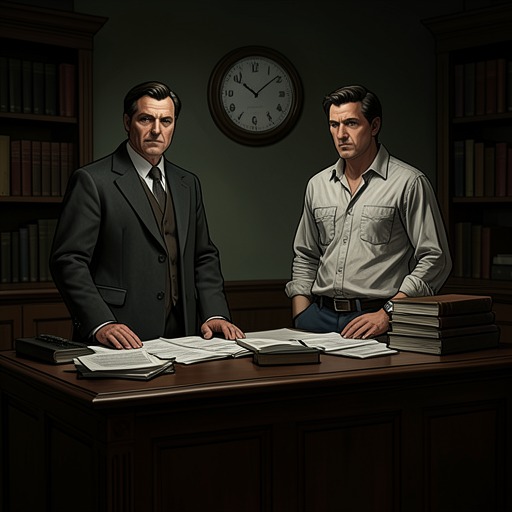
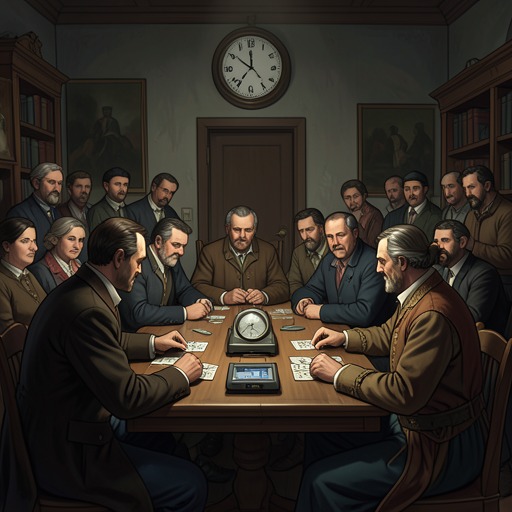
The wager emerges from a card-game conversation about whether the world has grown smaller. Stuart questions the claim that it can now be circled in three months; Fogg corrects him: the journey can be made in eighty days. Sullivan links that estimate to the opening of the railway section between Kholby and Allahabad on the Great Indian Peninsula Railway. The route is presented as evidence that new connections have compressed travel time, but Stuart insists that a timetable cannot account for bad weather, contrary winds, shipwrecks, railway accidents, or the possibility of a line being obstructed.
Fogg answers the practical objections with the same composure with which he continues playing cards. When Stuart challenges him to demonstrate the journey, Fogg accepts at once, first inviting him to make the trip and then agreeing to the proposed four-thousand-pound wager. The amount soon changes the scale of the challenge: Fogg declares that he will stake twenty thousand pounds against anyone willing to take the bet. His assurance that the unforeseen does not exist makes the dispute more than a contest of endurance. It places his faith in calculation directly against the interruptions Stuart has just enumerated.
The terms are exact. Fogg states that eighty days comprise nineteen hundred and twenty hours, or one hundred and fifteen thousand two hundred minutes. Stuart, Fallentin, Sullivan, Flanagan, and Ralph consult one another and accept. Fogg says that his twenty thousand pounds are deposited at Barings Bank and produces a cheque; a memorandum is drawn up and signed by the six participants. The clock strikes seven while the agreement is being completed, and Fogg’s companions offer to suspend their game so that he can prepare to leave.
Deadline, stake, and departure
Fogg gives the wager a date and an hour by consulting a pocket almanac. Since the day is Wednesday, October 2, 1872, he must be back in the same room at the Reform Club on Saturday, December 21, at a quarter before nine in the evening. If he misses that appointment, the twenty thousand pounds deposited in his name will legally belong to his opponents. The wager therefore measures success not by eventual arrival but by arrival at a specified place before a specified moment.
The stake also explains why the sum at risk does not represent all the money Fogg expects to need. He has committed half his fortune to the wager, while anticipating that the other half may have to be spent carrying out a difficult, perhaps unattainable, project. His calm manner conceals neither the size of the exposure nor the practical costs he foresees. The other men, meanwhile, are agitated less by the money than by the severity of the conditions they have accepted against their friend.
The departure is immediate rather than hypothetical. Fogg says that the train for Dover leaves at a quarter before nine and that he will take it that evening. Once the clock strikes seven, preparations become urgent: the debate at the card table has set a journey in motion, with less than two hours between the end of the meeting and the planned departure. The wager’s precision thus governs the story from its first practical consequence, turning a statement about what transport permits into a schedule Fogg must personally attempt to keep.
A timetable tested by interruptions
The eighty-day estimate depends on connected routes, yet the journey quickly exposes the difference between a schedule and an uninterrupted passage. At Kholby, Fogg learns that the railway is unfinished: fifty miles still have to be laid before the line reaches Allahabad. The newly opened section that helped make the projected duration persuasive does not mean that every part of the route is complete. The gap forces the travelers to proceed by other means, making the wager’s central difficulty visible in a concrete break between timetable and terrain.
Other passages recall the hazards Stuart raised at the club. On the Mongolia, the Red Sea wind makes the long ship roll fearfully; the passengers’ music and dancing stop, but the vessel continues toward the Strait of Bab-el-Mandeb without slowing. Fogg shows no outward anxiety about the wind or waves. Later, the crossing from New York to Liverpool aboard the Henrietta remains conditional: the sea must not become too rough, the wind must not turn east, and neither vessel nor machinery must suffer an accident if the ship is to cover three thousand miles in nine days. The narrative keeps those conditions in view even when the journey appears to be progressing smoothly.
The wager also makes delay something to calculate and recover. After the journey is interrupted by the Sioux, Fogg is told that he is twenty hours behind. Because he would otherwise have reached New York with eleven hours to spare before the steamer’s departure, he must make up eight hours. Fix proposes a sailing sledge as a means of doing so. That exchange turns the wager’s arithmetic into an operational problem: each lost hour changes the available choices, and a new mode of transport becomes valuable because it can restore part of the schedule.
From private bet to public market
Fogg expects his departure to cause a sensation, and the wager soon escapes the club. News spreads through the Reform Club and then through newspapers across England. The proposed journey becomes an argument in public: most papers, including the Times, the Standard, the Morning Post, and the Daily News, dismiss it as madness, while the Daily Telegraph gives it hesitant support. Readers take sides, and the Illustrated London News adds Fogg’s portrait, copied from a photograph at the club, to the public discussion.
The response does not remain an exchange of opinions. The British public places bets for and against Fogg, and his name enters betting books as though he were a racehorse. Phileas Fogg bonds appear on ‘Change, offered at par or at a premium; their changing demand makes public expectation visible as a market price. After an article in the bulletin of the Geographical Society circulates in the newspapers, demand declines, and the bonds are offered in increasingly large packages. The wager has become both a journey and a tradable estimate of whether Fogg can finish it.
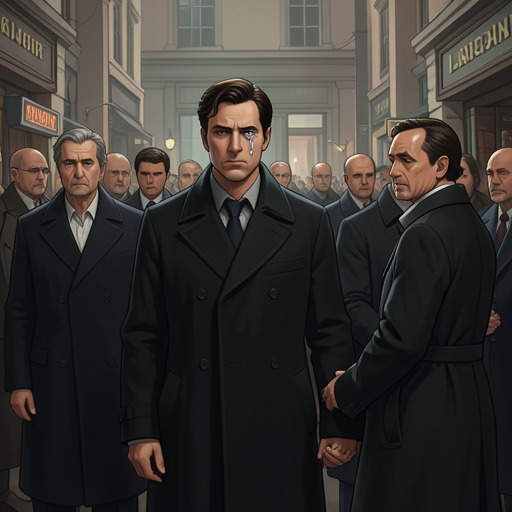
That estimate changes sharply when news breaks that the real bank robber, James Strand, has been arrested in Edinburgh on December 17. Three days earlier, Fogg had been regarded as a criminal pursued by the police; the new information restores him in public opinion as an honourable gentleman pursuing his journey. Newspapers return to the wager, the bonds become negotiable again, and new bets are made. The reversal shows how the public meaning of Fogg’s undertaking depends not only on his progress but also on information about the separate bank robbery that had made him a suspect.
Significance of the wager
The wager gives the journey a measurable dramatic structure: a start, a route, a fixed return appointment, and a fortune that changes hands if the deadline is missed. Its apparent precision is repeatedly set against circumstances that cannot be mastered by arithmetic alone: an unfinished railway, difficult seas, an attack that costs time, and the need to find alternative ways forward. Fogg’s confidence remains the wager’s governing premise, while each practical interruption tests what that confidence can accomplish.
At the same time, the bet makes private resolve a public spectacle. The club’s signed agreement generates newspaper debate, betting books, bonds, and shifts in market value; the journey’s meaning is continually revised by reports of progress and by the revelation that Fogg is no longer wanted as a suspected robber. The wager therefore binds together travel, money, reputation, and time. Its decisive question is not simply whether the world can be crossed in eighty days, but whether a person can make a real journey conform to a deadline stated with mathematical exactness.